Tennant20: Osmium Coating System
Discovery awaits
beneath an ultra-thin veil
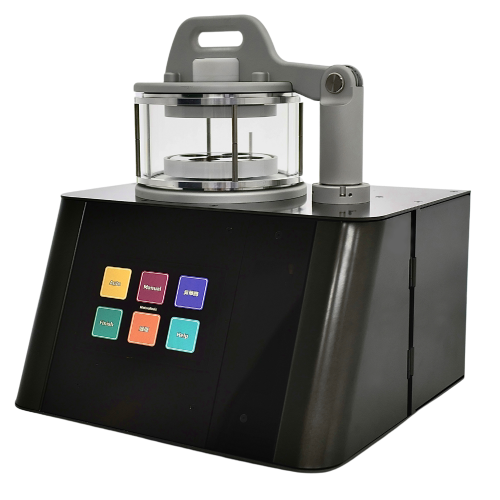
The next-generation osmium coater, designed for superior safety and ease of use.

1. Key Features of Tennant20
Consistent and Reliable Results
Proprietary feedback control maintains a constant current, minimizing variation between samples and ensuring consistent results regardless of the operator.
Safe and Clean Working Environment
A sealed design, combined with an integrated gas treatment and exhaust system, effectively suppresses osmium volatilization to ensure both researcher safety and environmental responsibility.
Intuitive Touchscreen Operation
Access all functions through a user-friendly touch interface. The built-in coating management feature allows for easy parameter recall and consistent results.
Low-maintenance Design
Automated consumable replacement alerts and a simplified design ensure stable, long-term operation. Furthermore, routine maintenance can be performed tool-free.

2. What is Osmium Coating?
Osmium coating is a process used to form a uniform, ultra-thin metallic film on a sample surface. This technique prevents surface charging during SEM observation and elemental analysis, enabling high-resolution imaging of even delicate structures.
3. Technology for High-Resolution SEM Imaging and Elemental Analysis
Ultra-thin Osmium Metal Film Formation in an Expanded Negative Glow Region
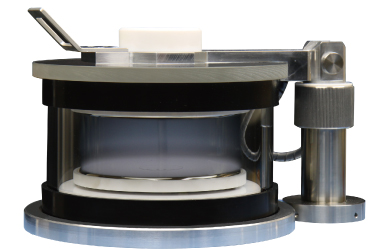
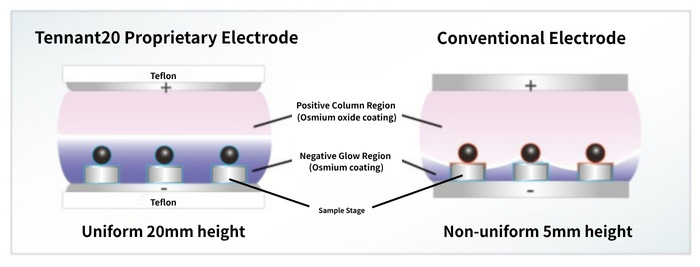
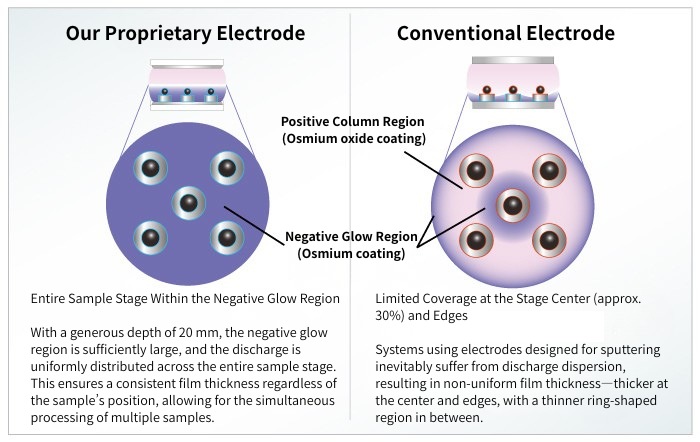
The system features specially designed parallel-plate electrodes. Insulating the electrode periphery with Teflon prevents discharge from concentrating at the edges. This ensures a uniform negative glow region across the entire sample stage, with an effective height increased to 20 mm.
This allows for the deposition of a robust and uniform osmium metal film, even for tall samples, regardless of their placement on the stage.
In contrast, conventional electrodes provide a shallow negative glow region of only 5 mm. Samples that exceed this height are exposed to the positive column region, resulting in the formation of osmium oxide films. Furthermore, because plasma tends to concentrate in the center and at the edges, the resulting conductive coating is non-uniform and vulnerable to electron beam damage, leading to inconsistent film thickness.
Minimizing electron beam damage with ultra-thin coatings that reduce granularity in images.
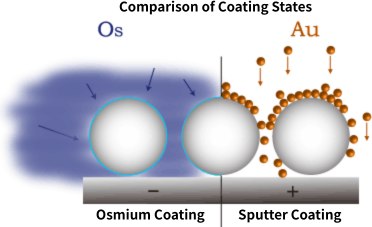
Osmium (atomic number 76) is a member of the platinum group elements.
The Tennant20 uses a plasma CVD process to envelop the sample in osmium gas, enabling the rapid formation of a smooth coating that reduces granularity in images.
This process ensures uniform coverage not only on the top and sides, but also on the underside and deep within complex structures. As a result, a robust ultra-thin film is formed without thermal damage, offering excellent resistance to electron beam damage.
Uniform, highly reproducible coating with precise thickness control across the entire sample stage.
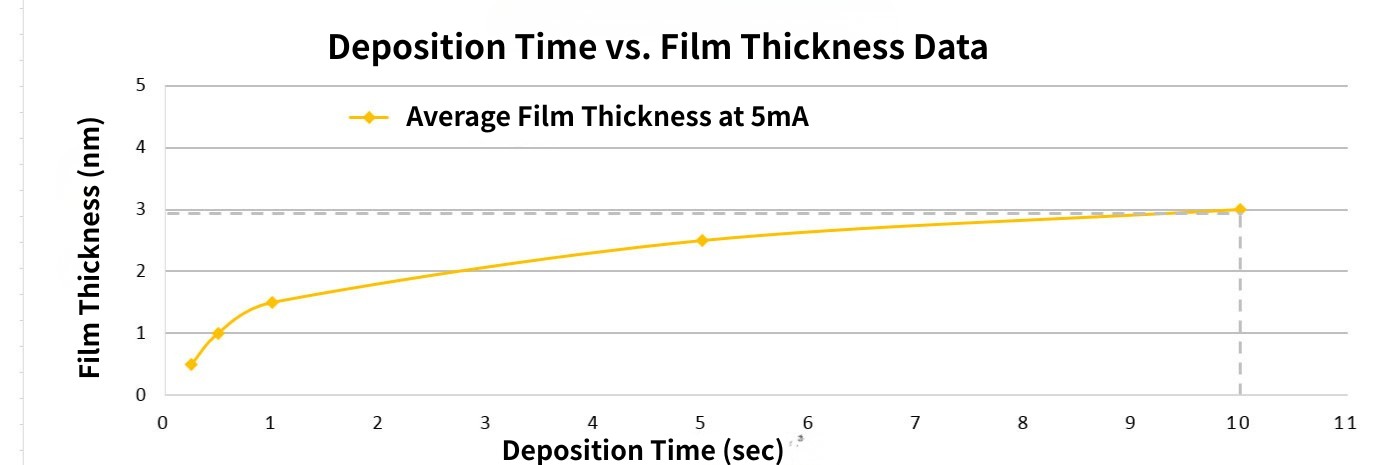
The system enables precise deposition from ultra-thin films (below 1 nm) to thicker layers, with timer control in 1/100-second increments. Because the thickness of the osmium conductive coating is approximately proportional to the discharge time, nanometer-level thickness control can be achieved easily and reliably.
Comparison of the negative glow region across the sample stage (Top View)

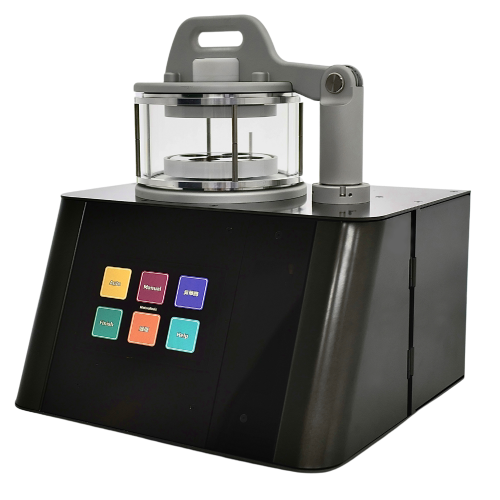
| Chamber Dimensions | Φ150 × 70㎜ |
| Sample Stage Capacity | ϕ10mm x35, ϕ15mm x10, ϕ30mm x5 |
| Touchscreen | 〇 |
| Vacuum Hold Function During Power-Off | 〇 |
| Sublimation Cylinder Open/Close Detection | 〇 |
| Automatic Exhaust Sequence | 〇 |
| Baffle Valve | × |
| Pump Capacity | 50 L/min |
| Current Consumption | AC 100 V, Max 10 A (including vacuum pump startup) |
| Weight | 22 kg |
| Max Power Consumption | 1 kW |
| External Dimensions | 390(W) × 385(D) × 435(H) mm |
| Bell Jar | High-vacuum O-ring seal type |
| Automatic Purge | Ambient air replacement in chamber (Evacuation: 30s / Pump stop: 10s x3 cycles) |
| Current Setting | 0.1 to 20.0 mA (Max limit current: 30 mA) |
| Film Thickness Setting | From 0.5nm |
| Auto | Film thickness setting |
| Manual | Custom settings for coating time, current, and gas filling time |
| EJECT | Forced exhaust: 180 sec |
| INSERT | Forced exhaust: Up to 2Pa |
| Finish | Forced exhaust: Up to 2Pa |
| Ampule Replacement | Forced exhaust: Up to 2Pa + 30 min |

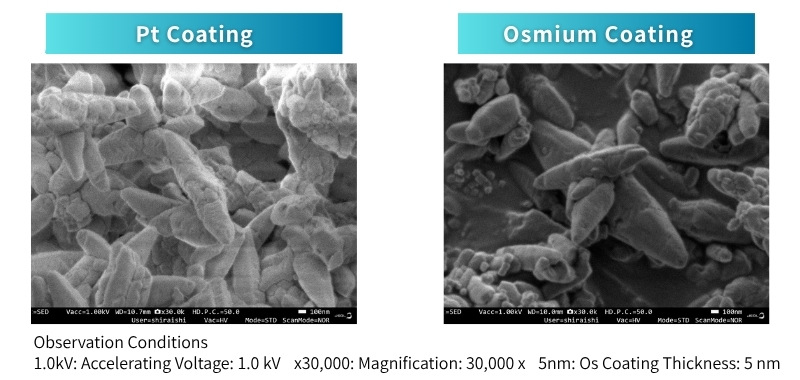
From nanoparticles and fillers to biomaterials.
Tennant20 maximizes contrast across a wide range of materials.
Spindle-shaped Calcium Carbonate Particles:
A Comparison of Pt and Osmium Coatings
Testimonials:
The contrast is incredibly sharp, allowing us to clearly observe the surface morphology and obtain high-quality SEM images.
Osmium coating significantly suppressed charging compared to other methods, making observation much easier and reducing our overall imaging time.
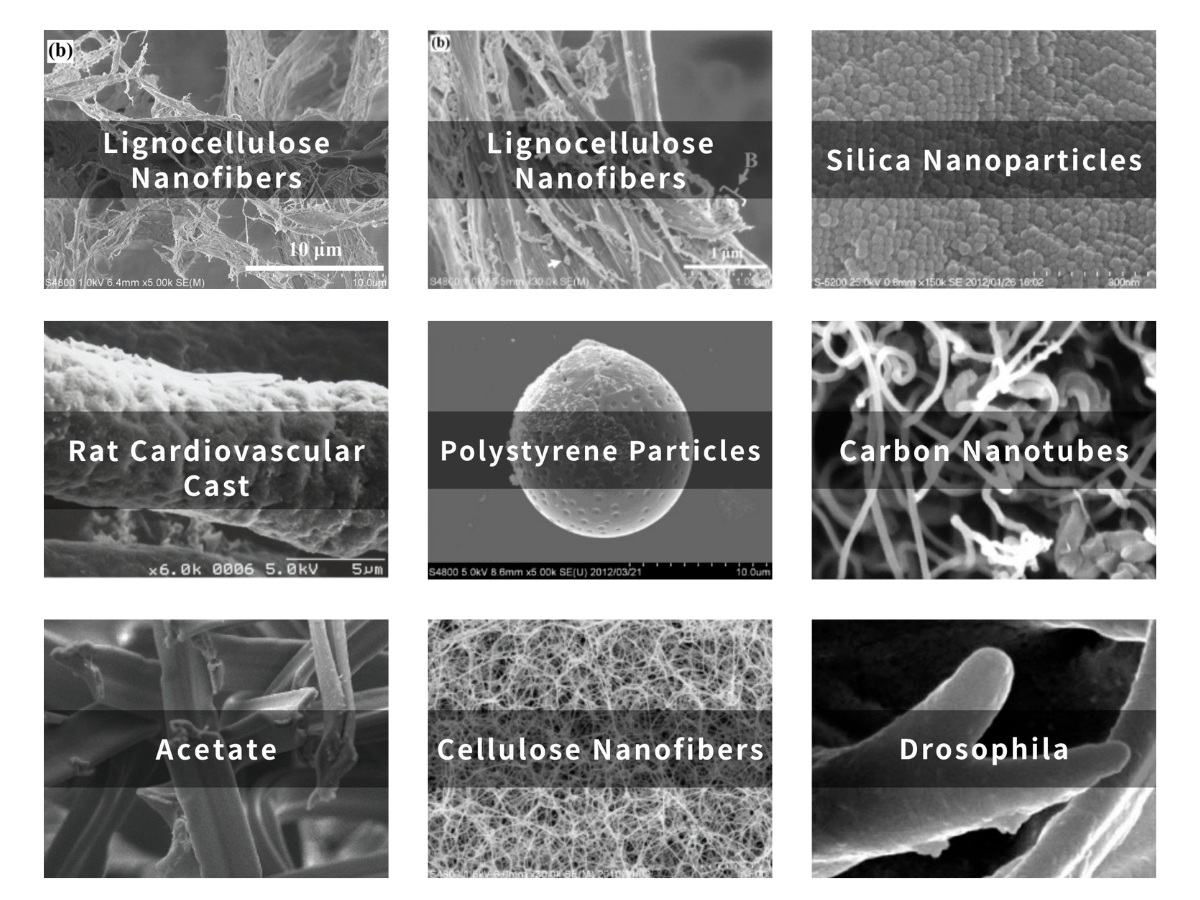
Application Gallery
Discover what’s possible with the Tennant20.
Explore our comprehensive collection of results across diverse materials, including head-to-head comparisons with sputter coating and real-world examples from published research.
Testimonials

Michigan State University
“Since the leap in microscopy resolution around 2000, we had been considering the adoption of FE-SEM. Recognizing that this required a superior coating solution, we first implemented the Neoc system. We later upgraded to the Tennant20 and have since coated numerous samples with osmium. We’ve seen a significant improvement in workflow efficiency thanks to automation.”
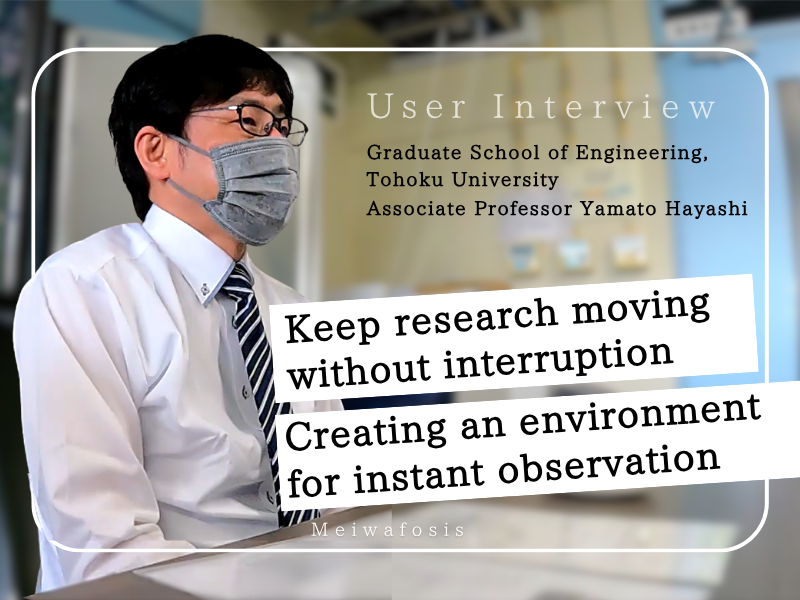
Graduate School of Engineering, Tohoku University
Department of Applied Chemistry
Associate Professor Yamato Hayashi
“Metal coating was essential for observing fine structures—such as nanoparticles and porous materials—at high magnifications. Previously, using shared facilities was time-consuming, but with this system in our lab, we can coat samples immediately and proceed smoothly to SEM observation. Its compact design and intuitive interface make it easy for even our students to operate.”
Trusted by researchers worldwide.

“Streamlined our workflow and significantly increased analytical throughput.”
“Achieved crystal-clear observation with grain-free films, perfectly suited for elemental analysis.”
“High reproducibility ensures consistent results, regardless of the operator.”
The Tennant20 is the choice of leading researchers in Japan and abroad.
Experience high-precision imaging of fine structures in your own lab today.


Keep your research moving forward
—take your results to the next level.
Quick questions are always welcome.
✅Wondering if Tennant20 fits your samples?
✅Looking for more details on features or support?
✅Want to request a demo or consultation?
Feel free to reach out about anything using the simple form below.
Our specialist team will get back to you shortly.